
A treatment no one expected to use on elephants
Acupuncture is usually associated with human medicine or, at most, small companion animals. It is not a standard tool in wildlife or elephant veterinary care. Yet in recent years, a series of unexpected cases has pushed conservation veterinarians to reconsider what is possible.
At Wildlife SOS, an Indian conservation organization focused on rescue and rehabilitation, that shift began not in theory, but in crisis. A critically injured baby elephant forced the team to explore whether an ancient medical system could offer something modern veterinary medicine alone could not.
What followed was an experiment in adaptation, necessity, and careful observation—one that would change how the team thought about recovery, pain, and long-term care for elephants.
Bani: a life changed in a single night
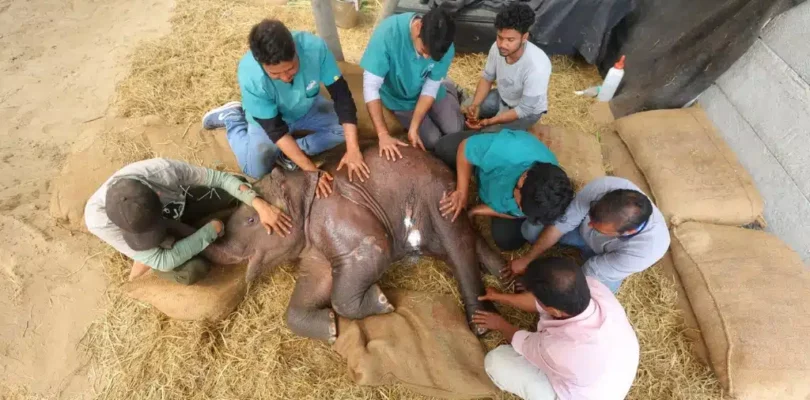
In the winter of 2024, a young Asian elephant arrived at a sanctuary in India. She was barely a year old. Wrapped in blankets and lying motionless in the back of a vehicle, she looked less like a patient and more like a body clinging to a final thread of life.
Her condition was severe. The veterinary team avoided dramatic language, but there was no need for explanation—her survival was uncertain.
She would later be named Bani.
Not long before her arrival, Bani had been caught in a train collision while crossing tracks with her herd. The impact killed her mother instantly and sent the calf tumbling down an embankment. The trauma left her paralyzed and unable to move her hind legs. In the chaos that followed, the herd disappeared into the forest, and the calf was left behind.
In a single moment, she lost her family, her mobility, and the wild life she was born into.
Early recovery: small signs of life returning
The first weeks after rescue were defined by uncertainty. Bani could not stand, and her hind limbs remained rigid. X-rays did not reveal major fractures, suggesting that her injury was neurological rather than skeletal.
But there were fragile signs of hope.
She began to move her tail slightly—an important indication that her spinal cord was not completely severed. Her appetite returned gradually, and she responded eagerly to bottle feeding. Most importantly, her behavior began to change. The withdrawn, unresponsive calf slowly started to engage with her surroundings again.
Recovery in such cases is rarely linear. Progress often appears in small, uneven steps rather than clear milestones. For Bani, those steps eventually led her caregivers to consider something unconventional.
Turning to acupuncture when standard options stall
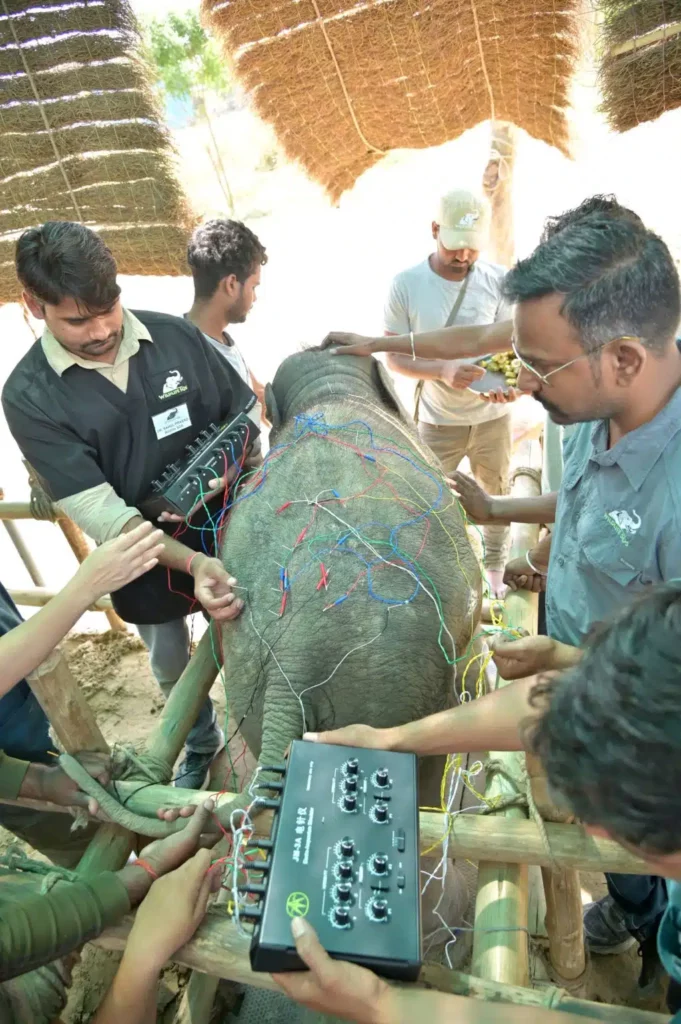
As Bani’s neurological recovery slowed, the veterinary team began exploring complementary therapies. This led them to acupuncture, a practice rooted in Traditional Chinese Veterinary Medicine (TCVM).
TCVM is built around four main approaches: acupuncture, herbal medicine, food therapy, and tui-na (a form of therapeutic massage). Rather than targeting a single symptom, it focuses on supporting the body’s overall balance and encouraging natural healing processes.
In acupuncture, fine needles are inserted into specific points on the body known as acupoints. These points are believed to influence nerves, muscles, circulation, and internal organ function.
According to veterinary researchers in TCVM, stimulation of these points can support pain relief, improve blood flow, and reduce inflammation. When electrical stimulation is added—known as electro-acupuncture—the effect is amplified. Studies suggest it may encourage the release of natural pain-relieving chemicals such as endorphins and support regenerative processes in damaged tissue.
While this approach is more established in small animals and horses, its application in elephants is rare.
Adapting a delicate technique to a massive body
Introducing acupuncture into elephant care is not as simple as scaling up a human treatment. Elephants present entirely different physical and logistical challenges.
Their size alone changes everything. Needle length, placement depth, and access points must be completely rethought. Even positioning the animal safely for treatment requires careful coordination between veterinarians and handlers. Sedation is not always possible or desirable, particularly in weakened or young animals.
Despite these challenges, the underlying physiological principles remain consistent across species. Nerve pathways still transmit signals. Inflammation still responds to stimulation. Circulation can still be influenced by targeted intervention.
This biological consistency is what made experimentation possible.
To support Bani, Wildlife SOS sought expertise from outside India. A veterinary acupuncture specialist from Thailand volunteered to assist, working with the team for only a few days. That short intervention marked a turning point.
The turning point: from paralysis toward movement
After receiving electro-acupuncture sessions, Bani’s condition began to shift. The changes were not immediate or dramatic, but they were meaningful.
Within weeks, she began to show increased strength in her hind limbs. First came assisted standing. Then short periods of balance without support. Eventually, she progressed to walking small distances.
For a calf that had arrived unable to move her legs at all, even partial mobility represented a major neurological improvement.
The team did not treat acupuncture as a standalone cure. Instead, it became part of a broader rehabilitation plan that included nutrition, physical support, and ongoing veterinary monitoring. But its contribution to her progress was difficult to ignore.
Expanding the approach to other elephants
Bani’s improvement encouraged further exploration of acupuncture within the sanctuary’s broader elephant care program. When training programs in TCVM became available in India, members of the veterinary team enrolled to deepen their understanding.
As experience grew, acupuncture began to be used in additional cases involving chronic pain, digestive disorders, and age-related degeneration.
Many captive elephants suffer from long-term health problems. Arthritis is common, particularly in older individuals. Foot disorders, caused by prolonged standing on hard surfaces, can lead to persistent discomfort and mobility issues. Digestive disturbances can also occur due to stress, diet, or age.
In one case, an older elephant experiencing recurrent digestive issues showed gradual improvement after acupuncture points associated with gastrointestinal function were stimulated alongside dietary adjustments.
In another, a senior elephant with arthritis in her leg regained a degree of mobility that allowed her to return to normal activities, including walking and bathing—behaviors that are important not just physically, but psychologically.
Blending modern veterinary care with traditional systems
The introduction of acupuncture into elephant medicine does not replace conventional veterinary treatment. Instead, it adds another layer to an already complex field of care.
Western veterinary medicine remains essential for diagnostics, surgery, infection control, and emergency intervention. Imaging technologies, antibiotics, and orthopedic treatment are irreplaceable in acute cases.
However, chronic conditions—especially those involving pain, mobility, and long-term degeneration—often require sustained management strategies. This is where complementary approaches like TCVM can play a role.
Rather than viewing the two systems as competing models, some veterinary teams now treat them as parallel tools, each addressing different aspects of recovery.
Bani’s long-term recovery and what it represents
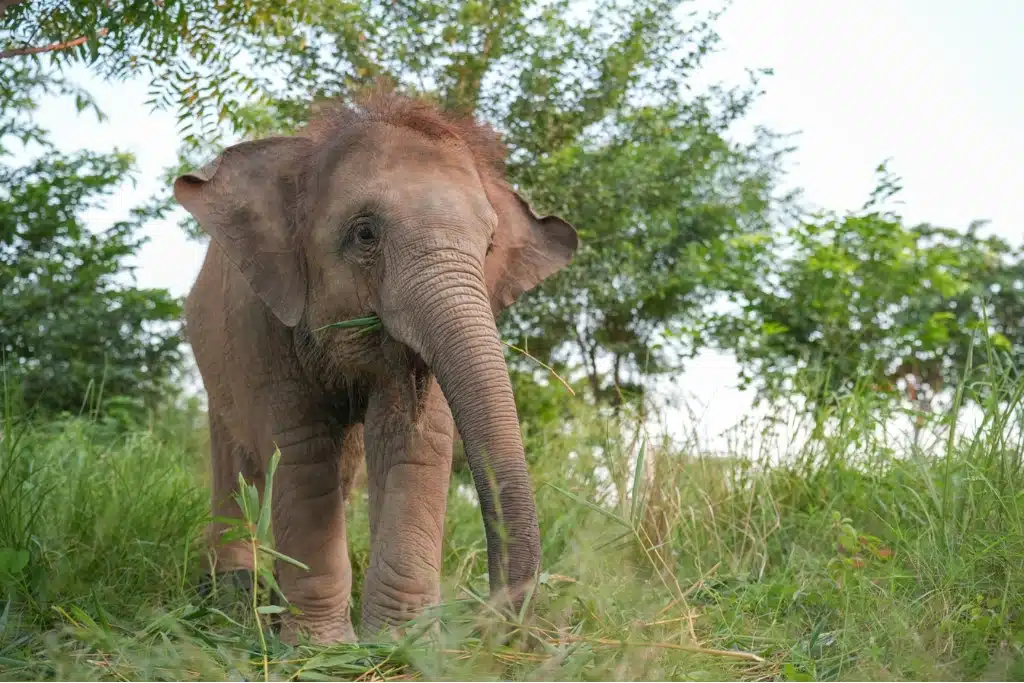
Nearly two years after her accident, Bani has developed into a lively young elephant. She walks, plays, and interacts with her environment with growing confidence. Her gait is not yet fully symmetrical, but improvement continues steadily.
More importantly, her quality of life has transformed. From a state of near-total paralysis and trauma, she has moved into active recovery and exploration.
Her case is not presented as a guaranteed outcome for all elephants. Instead, it illustrates what becomes possible when caregivers combine medical intervention with experimentation, adaptation, and openness to unfamiliar methods.
What this means for the future of elephant care
The use of acupuncture in elephants remains limited and highly specialized. It requires trained professionals, careful case selection, and integration with broader veterinary oversight. It is not a universal solution.
However, Bani’s case highlights an important shift in wildlife medicine: a growing willingness to explore interdisciplinary approaches when standard treatments reach their limits.
For conservation teams working with long-lived, complex animals like elephants, this flexibility can be crucial. Chronic pain, neurological injury, and age-related conditions often require long-term, multi-layered care strategies.
In this context, acupuncture is not simply an alternative therapy. It becomes part of a broader question: how far are humans willing to go to restore comfort, dignity, and mobility to animals in their care?
A final reflection
Bani’s story began with loss and paralysis. It evolved into a long process of rehabilitation shaped by persistence, experimentation, and careful observation.
Whether acupuncture will become a widespread tool in elephant medicine remains uncertain. But in this case, it contributed to something more fundamental than clinical improvement—it helped restore a sense of possibility.
For animals like Bani, that possibility is not abstract. It is movement returning to limbs that once could not move at all, and a future that slowly begins to open again.